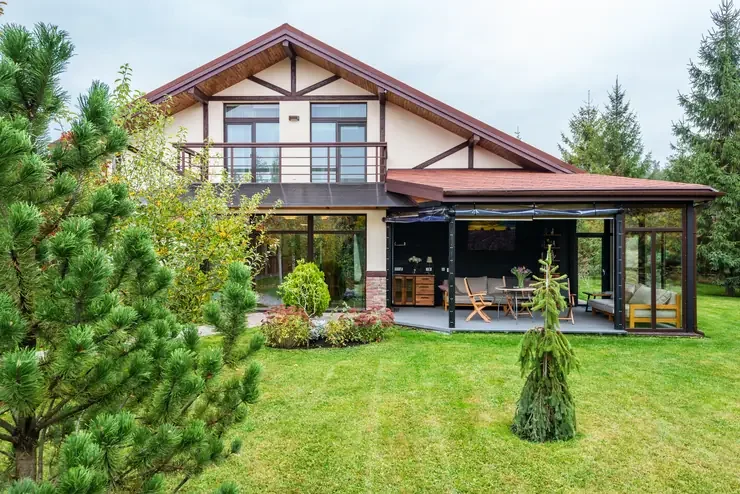
AAC block houses, shell or turnkey
AAC block houses in Chișinău and across Moldova: we build the walls in autoclaved aerated concrete blocks on adhesive, with reinforced concrete ring beams, and take the house to the shell, white-box or turnkey stage.
Leave a request
The data is processed in line with the privacy policy.
The rules of an AAC block house
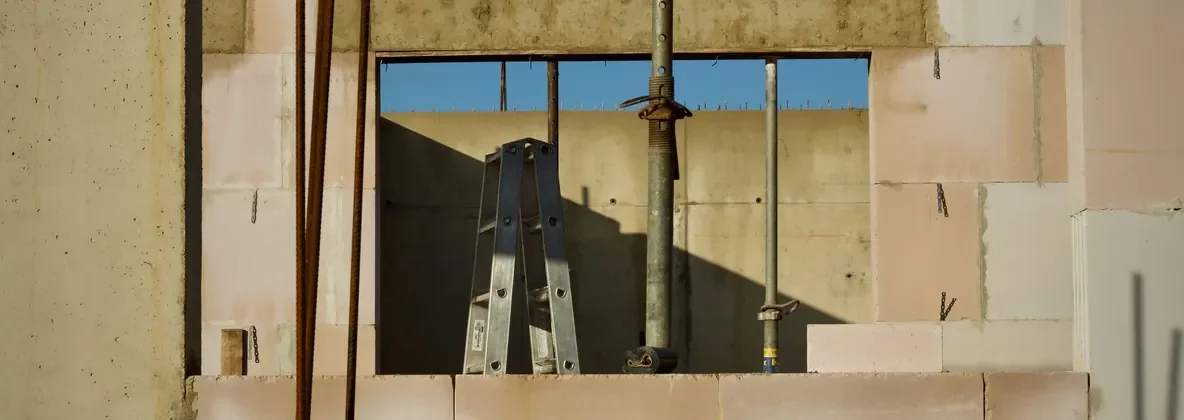
AAC is light and easy to cut, but a house built of it follows a few rules. Cracks in AAC houses usually start from a crooked first course or a missing ring beam.
First course on mortar
We lay the first course on mortar and level it carefully; the rest of the walls go up on adhesive with thin joints. A thin joint lets out less heat than a thick bed of mortar.
Ring beams
We pour ring beams over the walls and set lintels over windows and doors, so the masonry does not crack. Where the design asks, we also lay reinforcement in the joints every few courses.
Plaster on both faces
AAC soaks up water, so we plaster it inside and out. Left bare, the wall gets wet with every rain and the water in it freezes in winter.
The facade
AAC walls hold heat well; with facade insulation the house costs even less to heat. The boards are fixed with anchors made for aerated concrete, which grip in the porous block.
What an AAC block house costs
All pricesBesides the whole house, we also build just the AAC walls, as labour, priced per m³ of masonry.
| Work | Unit | Price from |
|---|---|---|
| House shellfoundation, walls, floor slabs, roof, with materials | m² | 5,800 lei |
| White-box housethe shell plus utilities, plaster, screed and windows, with materials | m² | 8,700 lei |
| Turnkey housethe white-box plus finishes, bathroom fittings and an insulated facade, with materials | m² | 14,500 lei |
| AAC block masonrylabour, on adhesive | m³ | 500 lei |
A house is priced per m² of built area, materials and labour included. Separate jobs are priced for labour: you buy the materials, or we bring them at the price on the receipt. The exact amount goes into the stage-by-stage estimate once we have seen the design, the plot and the soil.
AAC or brick?
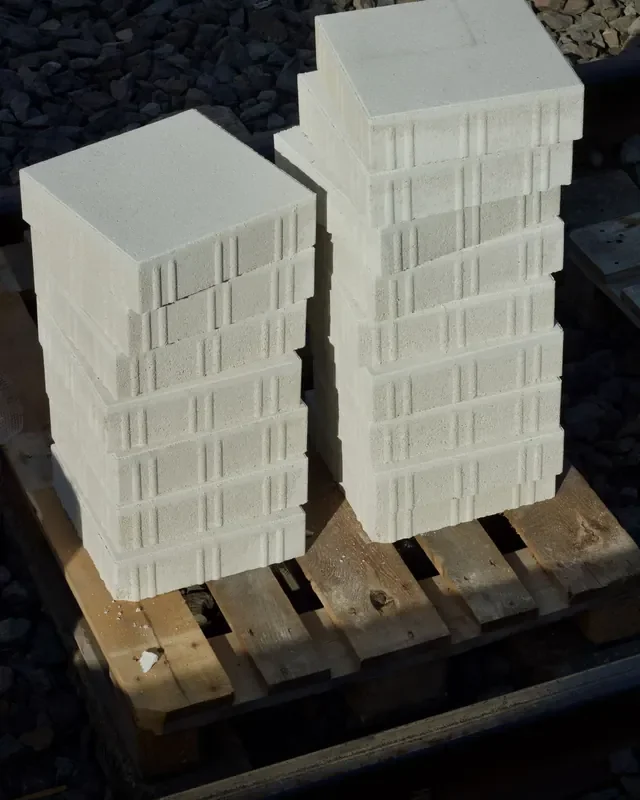
AAC is several times lighter than brick, holds heat better and goes up faster, which is why an AAC house usually comes out cheaper. Light walls also put less load on the foundation, which matters on weak soils. On the other hand, AAC holds wall plugs less well and needs protecting from water.
A brick house is heavier and dearer but tougher against knocks and damp. For a two-storey house both materials work, with ring beams and reinforced concrete slabs. If you already have a design, the material is in it; if not, choose it with your architect before the estimate.
The order of work on an AAC block house
We work as on any house shell, with care over the first course and the ring beams. For a 100-150 m² house the walls of one storey usually go up in two to three weeks.
Foundation and damp-proofing
We pour the foundation and lay a damp-proof layer between it and the first course of AAC. Without it, the porous block draws moisture from the concrete and the ground.
Walls on adhesive
We build the walls course by course, with joint reinforcement where the design calls for it. Blocks are cut to size on site with a saw, so openings come out exact.
Ring beams and slab
We pour the ring beams and the cast floor slab, then build the upper floor or attic. The ring beam runs round the whole outline, over every load-bearing wall.
Roof and handover
We put on the roof and hand over the shell, or carry on with the white-box. If we carry on, we plaster the walls as soon as we can after the roof, so the AAC does not stand bare for long.
Frequently asked questions
What are the pros and cons of an AAC block house?
Pros: it is light, warm and quick to build, and the house usually costs less than a brick one. Cons: it soaks up water if left unplastered and holds heavy fixings less well, so special anchors are used. With the right anchors, kitchen cupboards or a water heater hang without trouble.
How many storeys can be built in AAC?
For private houses, two storeys or a ground floor with an attic are no problem in AAC, with ring beams and reinforced concrete slabs. The design sets the number of storeys and the wall thickness, according to the load they carry.
Does an AAC block house need insulation?
A thick AAC wall holds heat well on its own, but with facade insulation the house is cheaper to heat. Decide with your architect, based on the wall thickness in the design. The facade can also be done later, after you move in.
Building in AAC?
Tell us the floor area and the number of storeys, and we tell you what the AAC house costs as a shell and turnkey. AAC is the lightest material we use for house construction in Chișinău.